Learning and organizational life cycles
1- Learning and organizational life cycles
The 'life cycle' or stage of development of an enterprise will impact the skill mix, and what constitutes an effective manager. As managers in open systems actively seeking to improve processes and systems, a modern manager can no longer be viewed simply as controlling what exists. لینک ترجمه
Table 3 - Enterprises cultural and strategic maturity
|
Life Cycle Stage |
Key Strategic/Cultural Features |
|
Embryonic
|
High levels of cohesion Dominant role of founder Outside help not valued Lack of procedures and planning systems Politics play an important role |
|
Growth |
Large variety of culture changes Levels of cohesion decline Emergence of middle management Tensions/conflict may arise in enterprises trying to get people to accept new ways of thinking Diversification of business activities Line/Staff differences |
|
Maturity
|
Institutionalization of values and beliefs Evolutionary rather than revolutionary changes Inertia may emerge in enterprise Strategic logic may be rejected |
|
Decline |
Culture may act as a defense against a hostile environment Major decisions may have to be taken Readjustment necessary |
2- Double loop learning and the learning organization
Knowledge also has a value that is not determined through its possession. It is also determined through the processes that impact the acquisition, transfer and expansion of the knowledge required by an organization. This is both a knowledge management and a learning process that can promote an organization’s agility and responsiveness to new and emerging customer demands. In other words, the value of knowledge is often tied to how fast individuals and teams within an organization can learn. It is valued by the organization, however for its strategic capacity to enhance productivity in the dollar value sense.
Senge (1992) stated: لینک ترجمه
Organizations only learn through individuals who learn. Individual learning does not guarantee organizational learning but without it no organizational learning occurs. (Senge, 1992:139)
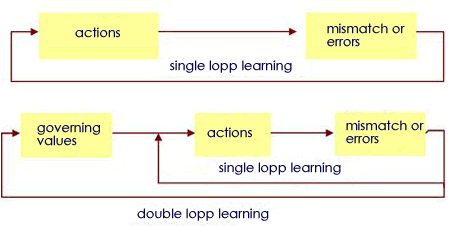
Generative learning emphasizes continuous, double-loop experimentation and feedback. Double-loop learning enhances the continual search for solutions while instilling behaviors and a culture where learning is embraced. Unlike adaptive learning, generative learning requires a new mindset and the capacity to create new visions for future realities. Senge (1992) suggested that generative learning is composed of:
-
Systemic thinking;
-
Shared vision;
- Personal mastery;
- Team learning; and
-
Creative tension between the vision and changing the current reality.
Essentially, generative learning builds in a redesign process based on optimal problem solving. This is in contrast to adaptive learning or single-loop learning where the focus is on solving current problems without examining the root causes of the problem or the learning behaviors that underpin the problem-solving process. As such, adaptive learning reinforces improvement by incremental steps more common to the managerial approach to leadership and problem solving.
Given the need for rapid change or the ability to respond to new operational realities, adaptive organizations are viewed as much less able to use learning to sustain and generate competitive processes, structures, people or systems.
The learning organization and organizational learning have at their core the translation of information (or data) into business success through individual, team, organizational and wider learning processes. The cycle of learning is addressed by a number of authors.
3- The learning cycle
After more than a decade two of the more influential approaches are those of Redding and Catalanello (1994) and Dixon (1994). Nancy Dixon builds this organizational learning cycle on previous studies detailing how individuals learn. Dixon suggests the organizational learning cycle has four steps as shown in the following diagram.
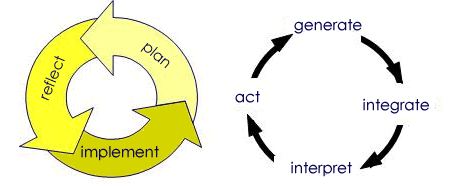
Redding & Catalanello, 1994:36) (Dixon, 1994:45)
Figure 2: Learning cycle
The above learning cycles of Redding and Catalanello, Dixon, or other variations (for example, see Argyris & Schon's double-loop learning, 1978:18-23; Kolb, 1984; Garrat, 1987; Revans, 1982) reinforce the need to view learning as a cycle that extends beyond the benign absorption of information for applied purposes . It can be viewed as a cycle that needs to have components managed to maximize its total impact. This process is never static. It varies with context, the individual and the content of learning.
The Redding and Catalanello figure depicts a simple learning cycle used in the management of learning and knowledge. How well we can transfer knowledge between individuals or improve an organization’s capacity to learning and to perform. Not all knowledge required can be tied to actions that produce known outcomes or found in processes used by individuals or the organization to achieve productive outcomes. Knowledge may be generated through experiences or completely unstructured events.
The value of learning to organizations can be appreciated if it is viewed in terms of its contribution to the speed organizations can innovate. The effectiveness of learning can be assessed by the speed, depth and breadth of learning (Redding & Catalanello, 1994:Ch2).
Speed of learning - the pace organizations are able to move through the learning cycle and the speed at which the organization can complete the learning cycle, will determine the opportunities available to learn.
Depth of learning - the ability of organizations to learn. How much knowledge is taken in at each learning cycle?
Breadth of learning - refers to the capacity of the organization to utilize the learning or "how extensively organizations are able to transfer new insights" (Redding, 1997:479-480).
Traditional learning in organizations takes a long time to occur. The time between market changes and the development of organizational structures and procedures to meet new conditions, and reconfiguration of organizational processes to strategic planning may only be completed when the next change impacts the organization. For the learning organization the implementation of change is through the realization that all processes within the management system are learning processes. The speed of the organizational learning cycle increases as the organization learns to learn and respond to change.
Learning is impacted by the specific context of the organization and the knowledge being absorbed, generated or transferred. Understanding the source and structure of knowledge is therefore a precondition for understanding how to manage knowledge as an asset and for determining its capital value.
4- Leading learning from being adaptive to generative
The role of the transformational leader is therefore to build workplace situations where everyday activities can be structured to enhance the depth, breadth and speed of learning. Enhancing an organization’s learning capability entails accelerating both individual and collective learning cycles. This requires learning to be much more than a contrived response to immediate needs. It must be managed as part of the long-term imperative to be competitive and responsive to changing social and market demands. McGill, Slocum and Lei (1992:5-17) illustrate this point by suggesting it is important to understand the difference between the organization’s ability to adapt (adaptive) and the organizations ability to learn (generative). The ability to learn gives the generative organization a competitive advantage over the adaptive organization, which is said to be 'learning disadvantaged' because while adaptive organizations may be able to transfer skills they cannot do so in a manner that enhances their sustainable capacity to change.
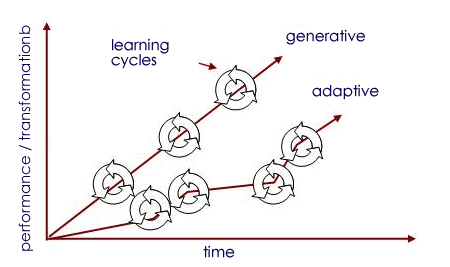
Figure 3: Managing learning to promote generate or adaptive change
The figure above illustrates how organizational learning can be used to generate enhanced depth, speed and breadth of learning (Redding, 1997:485). Adaptive learning (McGill et al., 1992) does provide opportunities for greater focus on process improvement. While McGill, Slocum and Lei illustrate how adaptive practices can support process improvement but they also argue such organizations are still 'learning disadvantaged' when responding to environmental factors.
Generative learning can be used to enhance organizational strategic readiness. In more stable environments organizations might promote adaptive learning in areas where they undertake a 'controlled' change process or need to fill skills gaps across multiple people or jobs. These approaches can still promote continuous quality improvement and meet incremental changes.
Research suggests generative learning is more able to assist organizations to develop through a sustainable capacity to learn and to change. Such learning can be focused at a process or systems level (Redding, 1997:485). However, learning becomes much more than an intervention controlled and targeted towards adapting actions to meet performance ends; it becomes a strategic capability.
Transformational leaders need to identify and reinforce the factors that enhance not only adaptive learning but also generative learning. It is on this base that greater competitive advantage can be built for those organizations seeking to be agile and responsive.
Transformation is not achieved through interventions that cause spurts of improvement; rather it is embedded in how people think, act and view their contribution to the organization. Generative learning is cross-process and systems-level issue that addresses not just how 'things are done', but how people and shared visions adapt to change and improve the speed, depth and breadth of learning.
Translated by: Dadkhah - Behnam
Source:Net